Ingredient check
Does Coenzyme Q10 Help Nerves? What the One Small Trial Found
Quick answer
Coenzyme Q10 has one small nerve trial. In 49 people with type 2 diabetes, 400 mg a day for 12 weeks came with better symptom scores and some better nerve tests, and no drug-related side effects. Quiet Nerves names CoQ10 but does not publish its amount, and it may interact with warfarin and insulin.
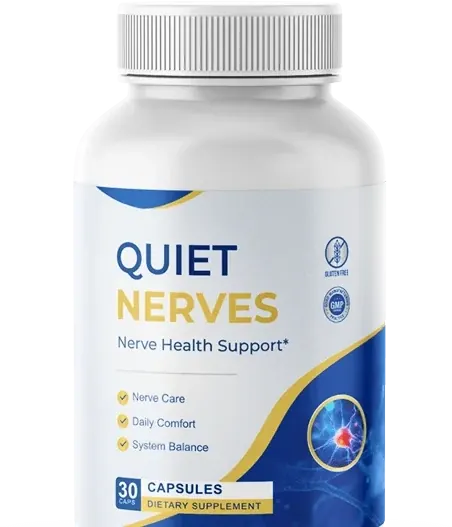
Coenzyme Q10, often shortened to CoQ10, is on many nerve labels. It is a compound your body already makes. That makes it sound safe and natural, but the real questions are simpler: has it been tested for nerves, at what dose, and who should be careful?
Here is what we found, using only the sources the Quiet Nerves site already cites.
Key facts
- CoQ10 is an antioxidant that your body makes and cells use in producing energy.
- One trial tested 400 mg a day for 12 weeks in 49 people with type 2 diabetes.
- Most of the reported gain compares people with their own starting scores, and not with the dummy group.
- Most reported side effects are small: restless sleep or a sour stomach.
- Warfarin and insulin are the two medicines flagged for a possible interaction.
- Quiet Nerves names coenzyme Q10 as ubiquinone. The amount is not published.
Basics
What is coenzyme Q10?
CoQ10 is a compound that sits inside cells, where it helps make energy. It also acts as an antioxidant. The body makes its own supply, and a supplement adds to that.
The form named on the Quiet Nerves list is ubiquinone, the common supplement form.
Trial
What did the CoQ10 nerve trial find?
Forty-nine people with type 2 diabetes joined the trial and took either 400 mg a day or a placebo for 12 weeks. In the CoQ10 group, symptom scores and some nerve signal tests improved, and no side effect was blamed on the drug (Hernandez-Ojeda et al., 2012).
| Point | Detail |
|---|---|
| People | 49 adults with type 2 diabetes |
| Dose | 400 mg a day |
| Length | 12 weeks |
| Found | Better symptom scores and some nerve signal tests |
| Side effects | No drug-related side effects reported |
Limits
How should you read a single small trial?
With care. Most of the reported gain compares people with their own starting scores, and not with the dummy group. That is a weaker kind of proof, because people often feel different after 12 weeks for reasons that have nothing to do with a capsule.
- It is one trial, not a pile of them.
- All 49 people had type 2 diabetes. Results may not apply to other causes of nerve symptoms.
- The dose was 400 mg a day. A product with a smaller or unknown dose is not the same test.
Doses
What doses of CoQ10 appear in other research?
A federal fact sheet reports that studies of rare inherited energy disorders used 600 to 3,000 mg a day safely (NIH ODS, mitochondrial disorders). Those studies treat a different problem, in a different group, so they say little about nerve symptoms.
They do show that CoQ10 has been given at large doses under study conditions. That is not advice to take more.
Safety
What are the safety notes for CoQ10?
Side effects tend to be small. Poor sleep and a sour stomach are the usual ones (NCCIH, coenzyme Q10). Studies at higher doses also noted a rash (NIH ODS, mitochondrial disorders).
Quiet Nerves
How much CoQ10 is in Quiet Nerves?
Not published. The brand names the ingredient and gives no number. So the 400 mg figure from the trial cannot be compared with one capsule.
| Item | What is published |
|---|---|
| Six ingredients named | Coenzyme Q10, turmeric (95% curcuminoids), L-carnitine, butcher's broom, alpha lipoic acid and magnesium glycinate |
| Amount of each one | Not published |
| Study of Quiet Nerves itself | Not published; none was found |
| Brand directions | Take 1 capsule a day, with food and a full glass of water |
| Label cautions and storage directions | Not published |
Better proof
What would a stronger CoQ10 trial look like?
Four changes would make the evidence much firmer.
- A placebo group in every comparison, so the result does not lean on starting scores.
- More people, so one lucky group cannot tilt the average.
- Longer follow-up. Single-ingredient nerve trials of other products ran from 5 weeks to a year.
- People with different causes of nerve symptoms, not only type 2 diabetes.
Until a trial like that exists, 400 mg for 12 weeks stays a promising note and not a rule.
Doctor first
Who should ask a doctor before taking CoQ10?
Anyone on warfarin or insulin, as flagged above. People who take several daily medicines also benefit from a pharmacist check, because supplements are not reviewed for safety before sale and natural does not always mean safe (NCCIH, using supplements wisely).
Quiet Nerves is sold for adults only. Pregnant or breastfeeding readers, and anyone with kidney or liver disease, should raise the whole ingredient list with a doctor and not just this one item.
Mix
Does CoQ10 add anything on top of the other five ingredients?
Nobody knows. No trial has tested the six-ingredient mix. Alpha lipoic acid, curcumin and CoQ10 are grouped as antioxidants in the brand's thinking, but that is an idea and not a measured result.
Stacking similar ingredients from two bottles is easy to do without noticing. If you already take a CoQ10 product, tell your pharmacist before adding another.
Next steps
How can you decide whether CoQ10 is worth trying?
- Get your symptoms checked so a doctor can find the cause.
- Ask about warfarin, insulin and any other medicine you take.
- Write a baseline score for your feet or hands before the first capsule.
- Use the 60-day window for Quiet Nerves as your trial period, and keep a weekly log.
FAQ
Frequently asked questions
Does coenzyme Q10 help nerves?
One small trial in 49 people with type 2 diabetes found better symptom scores and some better nerve tests on 400 mg a day for 12 weeks. It is a single small study.
What dose of CoQ10 was used for nerves?
400 mg a day for 12 weeks. Quiet Nerves does not publish its CoQ10 amount.
Does CoQ10 interact with medicines?
A possible interaction is flagged for warfarin and for insulin. Talk to a doctor or pharmacist first.
What are the side effects of CoQ10?
Mostly small ones, such as restless sleep or a sour stomach. Studies at higher doses also noted a rash.
Is the CoQ10 in Quiet Nerves ubiquinone?
The ingredient list names coenzyme Q10 as ubiquinone. The amount per capsule is not published.
Has Quiet Nerves been studied?
No study of the capsule or its six-ingredient mix was found.
Sources
Which sources does this post rely on?
Each source below is one that the Quiet Nerves site already cites. The links open the original pages.
- Hernandez-Ojeda et al., 2012. Hernandez-Ojeda J, et al. The effect of ubiquinone in diabetic polyneuropathy. J Diabetes Complications. 2012;26(4):352-358.
- NCCIH, coenzyme Q10. National Center for Complementary and Integrative Health. Coenzyme Q10. Last updated January 2019.
- NIH ODS, mitochondrial disorders. NIH Office of Dietary Supplements. Dietary Supplements for Primary Mitochondrial Disorders. Updated July 10, 2026.
- NINDS, peripheral neuropathy. National Institute of Neurological Disorders and Stroke. Peripheral Neuropathy. Last reviewed March 13, 2026.
- NCCIH, using supplements wisely. National Center for Complementary and Integrative Health. Using Dietary Supplements Wisely. Last updated January 2019.
- FDA, dietary supplements Q and A. U.S. Food and Drug Administration. Questions and Answers on Dietary Supplements. Content current as of August 27, 2026.
Our view
Our view
Does coenzyme Q10 help nerves? One small trial says it might in people with type 2 diabetes. One small trial is a hint, not a promise.
Quiet Nerves names CoQ10 but not how much. If that gap bothers you, the honest move is to wait for a printed amount. If it does not, a short, logged trial with a doctor in the loop is a fair way to learn how you feel.
Last updated . Written by the Quiet Nerves Editorial Desk at Goquietnerves. Medically reviewed by Dr. Eric Roberts, DPM, Podiatrist. This is general information, not medical advice. Quiet Nerves is a dietary supplement, not FDA approved, and not a treatment for neuropathy or any disease. Ask your own doctor or pharmacist about your own health and medicines.